Dear reader,
Here is my promised next post: Now that I'm almost a college graduate, I've become very nostalgic. Recently I was looking back through some old pictures from high school, and I can barely recognize myself from 9th grade. Because I was thin. Not like rail thin. Really not thin at all, actually. I think I was about a size 12-14 then, but compared to now, the difference is astounding. I think to myself, "Wow, I looked so good!" but I don't remember ever feeling like that at the time. I was too preoccupied with how fat I was compared to everyone else. Looking back at the pictures though, you can barely tell that I was bigger than everyone else. I blended in. Unfortunately, the problem with my self esteem goes way back. I was the chubby kid in elementary school, and for the majority of middle school for that matter. I was teased, some kids called me "fat" to my face, and I was miserable. Being so young, I didn't think much of my size, until I was made fun of, and I didn't understand why I was so much bigger. All of the kids at school seemed to eat the same food I did and we all did about the same amount of physical activity, so I didn't think there was anything I could do.
In middle school, my pediatrician became concerned and sent me to a nutritionist. Over the course of a year, my family improved our diet at home, switching from white bread to whole grain for example, and by the end of middle school I had lost 30 pounds. But I didn't really see a difference because the damage to my self image had been done. I never became health-obsessed, though I was always very conscious of what people thought of me, especially when I was eating. I felt their eyes watching me, judging me for the food I ate and for my size. Ironically, that was probably the best shape I have ever been in, but I couldn't appreciate it. Despite making gains towards health, during the summer between 10th and 11th grades, I broke my ankle. Over the next year and a half I had two surgeries to make repairs to my ankle, and every time I gained more weight. Exercise became even more of a challenge with my bad ankle, so I grew mostly apathetic about my weight.
In the news today, there seem to always be stories about "Body Shaming." Hearing about these stories makes my heart cry, because I have personally been the victim of people judging and making fun of my weight. You don't know what another person has been through, and if you are so bothered by a person's weight, find a more constructive way to tell them. Maybe invite them to do yoga with you instead of laughing at them behind their back. I promise you, most people who are overweight are well aware of it, and don't need you pointing it. If you're concerned for their health, and you know them well enough, tell them, but make sure to offer support when they need it. Be positive and encouraging as opposed to condescending and rude.
To sum it all up, my two main points are:
1. Appreciate your body. Human bodies are quite intricate and magnificent when you take the time to think about them. Your body does so much for you and it deserves your respect, whether you like how it looks or not. If you can appreciate your body for what it does, you will be one step closer to loving it.
2. Don't judge people by or for their weight. This should be common sense, but somehow it was overlooked. You don't know what others have gone through, so you have no right to judge them based on appearances only.
Sunday, January 11, 2015

Hiatus Over
Hello dear reader,
If you've been keeping up with my blog (which I highly doubt because I have VERY few readers), then you have probably noticed that it has been quite some time since my last post, and for that I do apologize. Life happens, you know. There have been a few times over the past few weeks where I thought, "Hey, I should write a new blog post," but I really didn't have anything to talk about. Today that changed. Right now my head has so many different thoughts floating around in my head, and I need to share them with someone... cue you! There are three(-ish) thoughts in particular, but one greatly deserves it's own post, so there will be another one coming shortly.
Ok, here it goes:
I'm graduating in May. That has really been sinking in with tomorrow being the first day of my last semester of college. What makes it even more unsettling is that I will be student teaching. I'd be lying if I told you that I'm not terrified. And excited. And completely uncertain. And I don't think it's all because of student teaching. I'm not sure that I actually see myself teaching for a long period of time. Don't get me wrong, based on what classroom experiences I've already had, I love it, but I don't necessarily see myself doing it for 5+ years, and that scares me. Is it common for people to have these kinds of doubts when they're about to enter the real world? Maybe its because there's so many things that I still want to do. And that brings me to my next thought:
I want to be a novelist. This isn't just a lofty dream either, I've been working on a manuscript for some time now and I finally reached the 50,000 word mark the other day. And now it's 150 pages long. 150! I can't even believe that I've written that much! It's nowhere near finished, but I have a goal of submitting it for publication by the end of this year. Right now I'm super motivated and excited about it, but my fear is that in a few months that enthusiasm will die down and this dream of becoming a novelist will just fade. I don't want that to happen.
I'm sorry that I didn't have any advice or insightful thoughts to share with you in this post, I promise you the next one will have more substance. If you have any ideas for future posts, please leave a comment.
Thanks for reading.
If you've been keeping up with my blog (which I highly doubt because I have VERY few readers), then you have probably noticed that it has been quite some time since my last post, and for that I do apologize. Life happens, you know. There have been a few times over the past few weeks where I thought, "Hey, I should write a new blog post," but I really didn't have anything to talk about. Today that changed. Right now my head has so many different thoughts floating around in my head, and I need to share them with someone... cue you! There are three(-ish) thoughts in particular, but one greatly deserves it's own post, so there will be another one coming shortly.
Ok, here it goes:
I'm graduating in May. That has really been sinking in with tomorrow being the first day of my last semester of college. What makes it even more unsettling is that I will be student teaching. I'd be lying if I told you that I'm not terrified. And excited. And completely uncertain. And I don't think it's all because of student teaching. I'm not sure that I actually see myself teaching for a long period of time. Don't get me wrong, based on what classroom experiences I've already had, I love it, but I don't necessarily see myself doing it for 5+ years, and that scares me. Is it common for people to have these kinds of doubts when they're about to enter the real world? Maybe its because there's so many things that I still want to do. And that brings me to my next thought:
I want to be a novelist. This isn't just a lofty dream either, I've been working on a manuscript for some time now and I finally reached the 50,000 word mark the other day. And now it's 150 pages long. 150! I can't even believe that I've written that much! It's nowhere near finished, but I have a goal of submitting it for publication by the end of this year. Right now I'm super motivated and excited about it, but my fear is that in a few months that enthusiasm will die down and this dream of becoming a novelist will just fade. I don't want that to happen.
I'm sorry that I didn't have any advice or insightful thoughts to share with you in this post, I promise you the next one will have more substance. If you have any ideas for future posts, please leave a comment.
Thanks for reading.
Sunday, October 19, 2014
Taking Time to De-Stressify your Life
Hello All,
It's the middle of October and that means exactly 3 things:
1) Pumpkin-Spice flavored EVERYTHING
2) Cooler temperatures (well, maybe someday in Texas)
and 3) Midterms are upon us!
While it is extremely important to study hard and do well on your exams, you're not going to do as well if you're totally stressed out, so today I'm going to talk about ways to De-Stressify your Life.
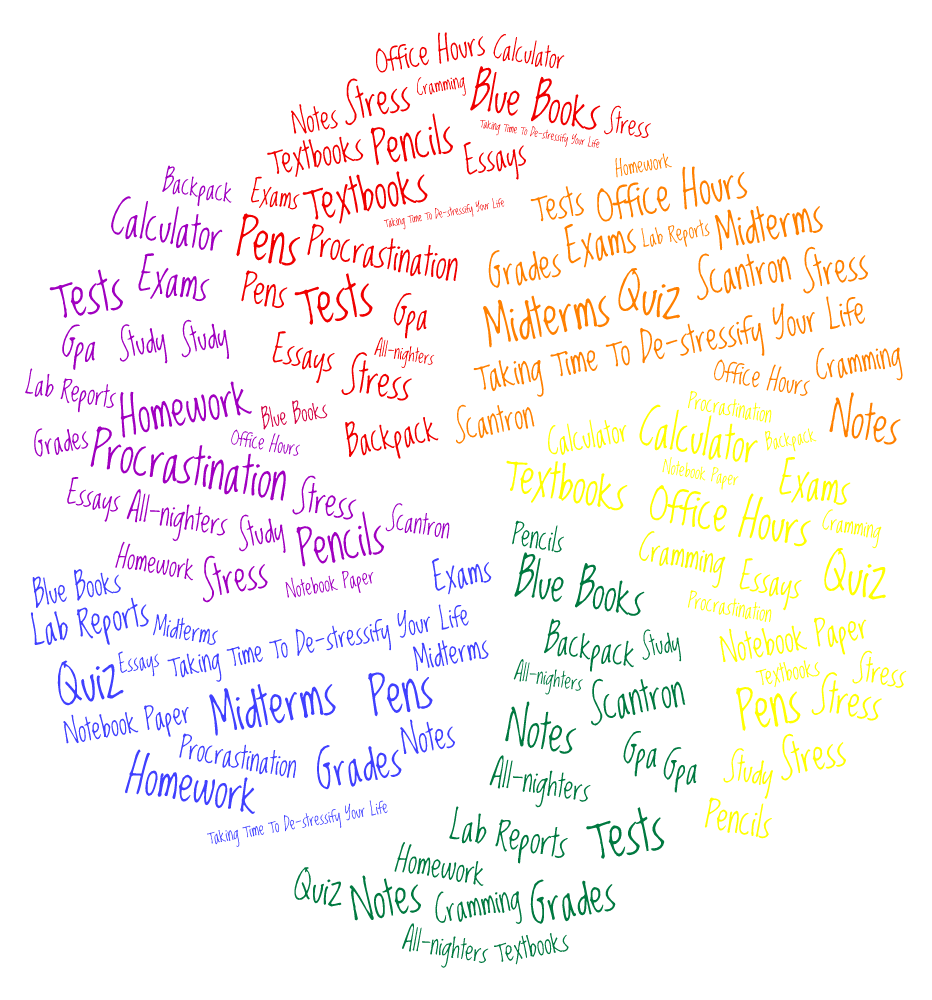 Generally, there are three main ways to de-stress:
1) Quiet Reflection or Meditation
2) Physical Activity
3) Doing something creative
Start by brainstorming a list of things that you really enjoy; activities that make you happy. This is your starting point whenever you need to take a break from studying. However, it is good to have more than one go-to for de-stressing. For example, I have many friends that bake when they're stressed, and if they follow that up with stress eating, you can see that this will lead down a dark path. Here are some additional suggestions if you need more ideas about how to de-stress:
1. Take a long hot shower or bubble bath
2. Try some breathing exercises
3. Have a 1 minute dance break
4. Get a massage; if you're with friends, get a massage circle going.
5. Watch a Movie (I don't recommend watching TV as it can easily turn into binge watching. Movies have a set time limit, so unless you're having a movie marathon, you'll most likely only be taking a 1.5-2 hour study break)
6. Clean (trust me, this works as evidenced by my near spotless apartment during midterms. You'll de-stress and have a clean living space)
7. Be social
8. Read something for fun
9. Go outside. Go for a walk/bike ride and enjoy the change of scenery and fresh air
10. Draw or Paint - really this just boils down to doing something creative be it knitting, cooking, or crafting.
11. Go shopping - nothing like a little retail therapy!
12. Make some music! - If you don't play an instrument, sing or get a beat going by tapping your pencil.
I hope you found this post interesting and helpful!
P.S. If you have any topic in particular that you'd like me to talk about in a post, please leave me a comment.
It's the middle of October and that means exactly 3 things:
1) Pumpkin-Spice flavored EVERYTHING
2) Cooler temperatures (well, maybe someday in Texas)
and 3) Midterms are upon us!
While it is extremely important to study hard and do well on your exams, you're not going to do as well if you're totally stressed out, so today I'm going to talk about ways to De-Stressify your Life.
1) Quiet Reflection or Meditation
2) Physical Activity
3) Doing something creative
Start by brainstorming a list of things that you really enjoy; activities that make you happy. This is your starting point whenever you need to take a break from studying. However, it is good to have more than one go-to for de-stressing. For example, I have many friends that bake when they're stressed, and if they follow that up with stress eating, you can see that this will lead down a dark path. Here are some additional suggestions if you need more ideas about how to de-stress:
1. Take a long hot shower or bubble bath
2. Try some breathing exercises
3. Have a 1 minute dance break
4. Get a massage; if you're with friends, get a massage circle going.
5. Watch a Movie (I don't recommend watching TV as it can easily turn into binge watching. Movies have a set time limit, so unless you're having a movie marathon, you'll most likely only be taking a 1.5-2 hour study break)
6. Clean (trust me, this works as evidenced by my near spotless apartment during midterms. You'll de-stress and have a clean living space)
7. Be social
8. Read something for fun
9. Go outside. Go for a walk/bike ride and enjoy the change of scenery and fresh air
10. Draw or Paint - really this just boils down to doing something creative be it knitting, cooking, or crafting.
11. Go shopping - nothing like a little retail therapy!
12. Make some music! - If you don't play an instrument, sing or get a beat going by tapping your pencil.
I hope you found this post interesting and helpful!
P.S. If you have any topic in particular that you'd like me to talk about in a post, please leave me a comment.
Sunday, October 12, 2014
Taking Advantage of Your College Environment
Hello Everyone!
I didn't get a chance to write up a post last week, and for that I do apologize, so for this post I'll combine two topics in a super-post I'll call "Taking Advantage of Your College Environment."

The first subtopic I'll be addressing is Campus Services. Most students are aware of at least a few of the campus services available to them such as an activity center and a health center, but there are usually many different services that many students never hear of. These services can include:
Now, I'll move on to my second topic: Getting to Know Your New Environment. This extends beyond becoming familiar with the campus to learning about the surrounding areas. It doesn't matter where your college is, there will always be interesting and fun things to do in the city/town. Go try out some local restaurants and shops and explore museums and local history. When I was in High School, I participated in a summer college program at the University of Mississippi. It's located in the quaint college town of Oxford, MS, and over the month I had getting to explore campus with my new friends. While seeing everything on campus was neat (the Grove was AWESOME), I think I had the most fun while exploring Oxford. One day I took a trip with a small group of friends out to see William Faulkner's home and on the way back to campus, we stopped in a local restaurant to snack on some chips and salsa, and that turned out to be one of the most memorable days of that entire summer.
It's incredibly important to like the city your college is in, because that's where you're going to (hopefully) be spending the next four years of your life, and while many freshmen like to stay on campus as much as they can to get fully immersed in the college experience, by their junior or senior year they've become bored because they've exhausted all of the entertainment available to them on campus. You'd be surprised by just how much there is to do in surrounding areas, so do some research or ask some people who live in the area (like maybe your professors... here's your chance to practice those Academic Communication Skills!).
I hope you found this post helpful and informative! Next week (or hopefully sometime later this week) I'll be talking about managing your college environment including ways to avoid procrastination and get through midterms without a hitch, so please check back soon! Thanks for reading!
I didn't get a chance to write up a post last week, and for that I do apologize, so for this post I'll combine two topics in a super-post I'll call "Taking Advantage of Your College Environment."
The first subtopic I'll be addressing is Campus Services. Most students are aware of at least a few of the campus services available to them such as an activity center and a health center, but there are usually many different services that many students never hear of. These services can include:
- a post office
- Multicultural/Diversity center
- Career Center
- Counseling Center
- Study abroad office
- Student escort service
- Notary
- Discounted tickets
- Women's Center
Now, I'll move on to my second topic: Getting to Know Your New Environment. This extends beyond becoming familiar with the campus to learning about the surrounding areas. It doesn't matter where your college is, there will always be interesting and fun things to do in the city/town. Go try out some local restaurants and shops and explore museums and local history. When I was in High School, I participated in a summer college program at the University of Mississippi. It's located in the quaint college town of Oxford, MS, and over the month I had getting to explore campus with my new friends. While seeing everything on campus was neat (the Grove was AWESOME), I think I had the most fun while exploring Oxford. One day I took a trip with a small group of friends out to see William Faulkner's home and on the way back to campus, we stopped in a local restaurant to snack on some chips and salsa, and that turned out to be one of the most memorable days of that entire summer.
It's incredibly important to like the city your college is in, because that's where you're going to (hopefully) be spending the next four years of your life, and while many freshmen like to stay on campus as much as they can to get fully immersed in the college experience, by their junior or senior year they've become bored because they've exhausted all of the entertainment available to them on campus. You'd be surprised by just how much there is to do in surrounding areas, so do some research or ask some people who live in the area (like maybe your professors... here's your chance to practice those Academic Communication Skills!).
I hope you found this post helpful and informative! Next week (or hopefully sometime later this week) I'll be talking about managing your college environment including ways to avoid procrastination and get through midterms without a hitch, so please check back soon! Thanks for reading!
Sunday, September 28, 2014
Academic Communication Skills
This week in {ruth} speaks college, I'll be sharing a bit about academic communication. First of all, proper academic communication is a skill that transcends your college career, and will be of great importance to you later in life as you are applying and interviewing for internships and jobs, and when you are employed and need to email or have a discussion with your boss or your coworkers.

As a brief introduction into academic communication, watch this video from the University of Victoria! It's as educational as it is hilarious!
If you'd rather skip the video or you just watched it, some of main points from this video are:
1. Know how to address your professor - some professors are cool with you calling them by their first name, others may wish to be called "Professor" or "Doctor ____". Your professor will typically tell you on the first day how they would like to be addressed.
2. If you have a quick question, it's best to just talk to your professors after class. If your question is longer, you can go to your professor's office hours or send them an email.
-When emailing a professor, use appropriate language and formatting [no text talk or emoticons! :)] and make sure to include your name, course number, and section number, so that your professor knows exactly who is emailing them and what class you're in. You should also your course number and a description of your email in the subject bar. This is especially important since many professors teach more than one class, sometimes even different subjects, so this will help them be able to respond to you more efficiently.
3. When talking to your professor in person or emailing them, try to be direct and to the point. If you are meeting with them in person, maybe jot down a quick list of what all you want to discuss, so you don't forget about something that you wanted to talk with your professor about.
4. Be cautious and respectful when talking with a professor about grades. Try to ask for their reasoning behind your grade or advice on how to improve your grades in the future.
An additional aspect of academic communication that is important to be aware of is Non-Verbal Communication. This includes facial expression, gestures, body language and posture, proximity, eye contact, and overall appearance. These are all things that will be of greater importance later on in life as you interview for internships and jobs, so it's a good idea to begin practicing these behaviors and skills now.
As a brief introduction into academic communication, watch this video from the University of Victoria! It's as educational as it is hilarious!
If you'd rather skip the video or you just watched it, some of main points from this video are:
1. Know how to address your professor - some professors are cool with you calling them by their first name, others may wish to be called "Professor" or "Doctor ____". Your professor will typically tell you on the first day how they would like to be addressed.
2. If you have a quick question, it's best to just talk to your professors after class. If your question is longer, you can go to your professor's office hours or send them an email.
-When emailing a professor, use appropriate language and formatting [no text talk or emoticons! :)] and make sure to include your name, course number, and section number, so that your professor knows exactly who is emailing them and what class you're in. You should also your course number and a description of your email in the subject bar. This is especially important since many professors teach more than one class, sometimes even different subjects, so this will help them be able to respond to you more efficiently.
3. When talking to your professor in person or emailing them, try to be direct and to the point. If you are meeting with them in person, maybe jot down a quick list of what all you want to discuss, so you don't forget about something that you wanted to talk with your professor about.
4. Be cautious and respectful when talking with a professor about grades. Try to ask for their reasoning behind your grade or advice on how to improve your grades in the future.
An additional aspect of academic communication that is important to be aware of is Non-Verbal Communication. This includes facial expression, gestures, body language and posture, proximity, eye contact, and overall appearance. These are all things that will be of greater importance later on in life as you interview for internships and jobs, so it's a good idea to begin practicing these behaviors and skills now.
Tuesday, September 16, 2014
Importance of Getting Involved on Campus (And new exciting things!)
The rule I generally hear is that students should try and be in at least two organizations or clubs; one that aligns with your major/degree/career choice and one that is something you're interested in. My freshman year, I joined a Pre-Health society and a volunteer organization called Learn to Be, where I could tutor kids online. These checked off the two boxes for me. At the same time, don't go overboard with the organizations because you will feel like you don't actually have time for classes. Try reminding yourself that the primary reason you are in college is to get an education, so classes should come first. If you find out later on that you're too involved, it's ok to cut back. Trust me, the club isn't going to hate you for leaving because they're all college students too and they understand how important it is for you to be able to manage your time well.
Now I want to move into why getting involved is so crucial to your college career.
1. Make friends! If this isn't your main reason for joining a group, it should be a close second or third.
2. Tutoring/Study Groups/Advice from others
3. Events/Parties/Activities - most clubs will have at least a few events each semester, so this can give you an opportunity to relax and have fun.
4. Carpools - this kind of goes with making friends. It's extremely possible that others in your group have a car, and might drive you places if you don't.
5. Study break - because studying all the time can drain you and leave you mentally exhausted (not a great thing when you have a test later in the week)
6. Leadership experience and Community service
7. Networking - Maybe the student sitting next to you works in a research lab or has this sweet internship lined up. He or she could possibly help you out later on.
8. Resume - probably the most cliche thing related to academics and clubs. Yes, you can put it on your resume and it may make you look better to interviewers
9. Teacher recommendation/References - most clubs/organizations have to have a faculty sponsor.
Wednesday, September 3, 2014
Organization and Study Tips for College
For many college students around the country, this is the second week of classes, which means exams are anywhere from 2-4 weeks away. That might still seem like a lot of time, but as the coursework starts picking up, it's easy to get overwhelmed as that time flies by, so here are some organization and study tips for college students.
 1. Invest in a planner. No, I do not mean spend $50 on a 5-in-1 life planner, address book, farmers almanac, 5 year calendar, huge spiral bound monstrosity. Yes, these do work wonderfully for some people, and if you are one of those people, please be my guest. What I mean is that you should invest time and energy into setting up your planner and continually using it throughout the year. When I get my syllabi at the beginning of each semester, I like to go into my planner and mark all of the test dates and project due dates for the entire semester. Occasionally these dates may get shuffled around, but at least you'll have it in your planner to begin with, and then you can scratch it out and rewrite it or draw a huge arrow from the original date to the new date. You also have to invest a few minutes outside of class to write down homework assignments and then check to make sure you've completed everything that needs to get done. Usually if I don't have any upcoming assignments in a class, I'll make a note of that too, just so that when I'm looking back through my planner I know I haven't forgotten something for that class.
2. Use sticky notes. Seriously, there are a million different practical applications for the usage of sticky notes. They make marvelous book marks that you can annotate and they're really handy for reminding you of stuff. I like to make notes of assignments and due dates on sticky notes and post them on the wall above my desk. When I finish the assignment, I take it down, crumple it up, and throw it in the trash can, giving me a wonderful feeling of accomplishment until I look back up at the wall and see at least 10 more sticky notes waiting to be removed. Basically however you choose to use them, sticky notes are wonderful little things!
3. Keep your course materials together. Some people like to have a different folder or binder for each class, so if that works for you, go ahead! I personally don't like constantly having to switch out binders, mostly because I'm terrified I'll bring the wrong one by mistake. However you choose to keep papers and materials organized, make sure you continued to use it. It can become really easy to just cram a bunch of handouts into the front pocket of a binder, but then you end up having to shuffle through a huge stack of paper to find what you're looking for, and it takes forever. So, I recommend using dividers or one of those accordion pocket folders to keep papers organized by class and, if you're really ambitious, by subsection.
4. Flashcards. We've now moved on to "study" tips, and the first big one is FLASHCARDS! The reason the flashcards are so popular is that they work! True, you may merely be memorizing the concepts, but hey, sometimes that's all it takes to do well on a test. Some people like using online flashcard websites and programs, and again, if this works for you, do it! I'm a personal fan of handwriting my own flashcards out on note cards (usually note cards that I've cut in half so's to save paper). I find that simply writing out the concepts onto the flashcards helps me, and having the physical flashcards with me in my backpack allows me to review/study, with or without internet access during short breaks of time that I would normally just waste playing a game on my phone.
5. Read the textbook. Your professor assigned it for a reason: it will help you do well in the class. I'm not saying that you have to read ahead in the book, so that you already know exactly what your professor is talking about, but it's good to not fall really far behind. I remember for one of my intro biology classes, I felt fairly comfortable with the material, so I chose not to read the book, assuming that attending lectures and workshops would be enough to do well. During the week of the first test, other students told me that there would apparently be a significant part of the test that came directly from the book instead of the lectures, so I panicked and started reading right away, and, wouldn't you know it, I fell asleep after reading the first 3 pages. I mean, deep, deep sleep; like I think I crashed for about 2 hours because the book was so boring, I was overwhelmed with how much I needed to read, and I was exhausted. Please, learn from my mistakes and read the assigned parts of the book!
6. Learn your learning style. Are you a visual learner or an auditory learner? How about a kinesthetic or logical learner or a solitary or social learner? Figure out what learning styles work best for you, and use it to your advantage. If you're an auditory learner, ask your professor if you can record the lectures and listen to them again. If you're visual, study figures and diagrams more closely and try to write things out. If you're not sure what learning style you have, you can take a quiz online such as these: Educationplanner.org
LDpride.net
Vark: A guide to learning styles
7. Form a study group and take turns "teaching" the concepts to one another. Research shows that being able to teach a concept indicates mastery of the concept, so while you're studying with your friends, take a break and try to explain it to them without using any of your notes. If you're able to clearly explain the concept to them, then you probably understand it enough yourself to do well on the test/assignment. Also, when working with a study group, try and use a variety of learning styles to help all of the members of the group.
I hope that these tips have given you new ideas about different things to try (or not to try) to help you do well in your classes this semester, or to help you stay organized and on top of things. Thank you for reading my blog, and please check back here often for new posts.
2. Use sticky notes. Seriously, there are a million different practical applications for the usage of sticky notes. They make marvelous book marks that you can annotate and they're really handy for reminding you of stuff. I like to make notes of assignments and due dates on sticky notes and post them on the wall above my desk. When I finish the assignment, I take it down, crumple it up, and throw it in the trash can, giving me a wonderful feeling of accomplishment until I look back up at the wall and see at least 10 more sticky notes waiting to be removed. Basically however you choose to use them, sticky notes are wonderful little things!
3. Keep your course materials together. Some people like to have a different folder or binder for each class, so if that works for you, go ahead! I personally don't like constantly having to switch out binders, mostly because I'm terrified I'll bring the wrong one by mistake. However you choose to keep papers and materials organized, make sure you continued to use it. It can become really easy to just cram a bunch of handouts into the front pocket of a binder, but then you end up having to shuffle through a huge stack of paper to find what you're looking for, and it takes forever. So, I recommend using dividers or one of those accordion pocket folders to keep papers organized by class and, if you're really ambitious, by subsection.
4. Flashcards. We've now moved on to "study" tips, and the first big one is FLASHCARDS! The reason the flashcards are so popular is that they work! True, you may merely be memorizing the concepts, but hey, sometimes that's all it takes to do well on a test. Some people like using online flashcard websites and programs, and again, if this works for you, do it! I'm a personal fan of handwriting my own flashcards out on note cards (usually note cards that I've cut in half so's to save paper). I find that simply writing out the concepts onto the flashcards helps me, and having the physical flashcards with me in my backpack allows me to review/study, with or without internet access during short breaks of time that I would normally just waste playing a game on my phone.
5. Read the textbook. Your professor assigned it for a reason: it will help you do well in the class. I'm not saying that you have to read ahead in the book, so that you already know exactly what your professor is talking about, but it's good to not fall really far behind. I remember for one of my intro biology classes, I felt fairly comfortable with the material, so I chose not to read the book, assuming that attending lectures and workshops would be enough to do well. During the week of the first test, other students told me that there would apparently be a significant part of the test that came directly from the book instead of the lectures, so I panicked and started reading right away, and, wouldn't you know it, I fell asleep after reading the first 3 pages. I mean, deep, deep sleep; like I think I crashed for about 2 hours because the book was so boring, I was overwhelmed with how much I needed to read, and I was exhausted. Please, learn from my mistakes and read the assigned parts of the book!
6. Learn your learning style. Are you a visual learner or an auditory learner? How about a kinesthetic or logical learner or a solitary or social learner? Figure out what learning styles work best for you, and use it to your advantage. If you're an auditory learner, ask your professor if you can record the lectures and listen to them again. If you're visual, study figures and diagrams more closely and try to write things out. If you're not sure what learning style you have, you can take a quiz online such as these: Educationplanner.org
LDpride.net
Vark: A guide to learning styles
7. Form a study group and take turns "teaching" the concepts to one another. Research shows that being able to teach a concept indicates mastery of the concept, so while you're studying with your friends, take a break and try to explain it to them without using any of your notes. If you're able to clearly explain the concept to them, then you probably understand it enough yourself to do well on the test/assignment. Also, when working with a study group, try and use a variety of learning styles to help all of the members of the group.
I hope that these tips have given you new ideas about different things to try (or not to try) to help you do well in your classes this semester, or to help you stay organized and on top of things. Thank you for reading my blog, and please check back here often for new posts.
Subscribe to:
Posts (Atom)